In plain language
Freight moves best when each tier does what it is good at. Railroads move heavy loads between cities with less fuel than any other land mode. Inside the city, an automated guideway network streams small standard subcontainers between the rail terminal, warehouses, shops and neighborhoods, above the traffic. At the end, a cargo bike, pickup or van carries the subcontainer the last few blocks. One container standard, one chain-of-custody record and one booking system tie the three tiers together.
This is the invention described in U.S. patent application 19/356,062, Automated Guideways Facilitating 3-Tiered Cargo Shipments. Everything on this page about the invention comes from the application as filed and the claims filed with it.
For railroads
Rail already wins the long haul. The short miles decide who gets the freight.
Ton-miles per gallon of diesel that U.S. freight railroads averaged in 2018.
Association of American Railroads
Rail's fuel efficiency per ton-mile compared with trucks.
Association of American Railroads
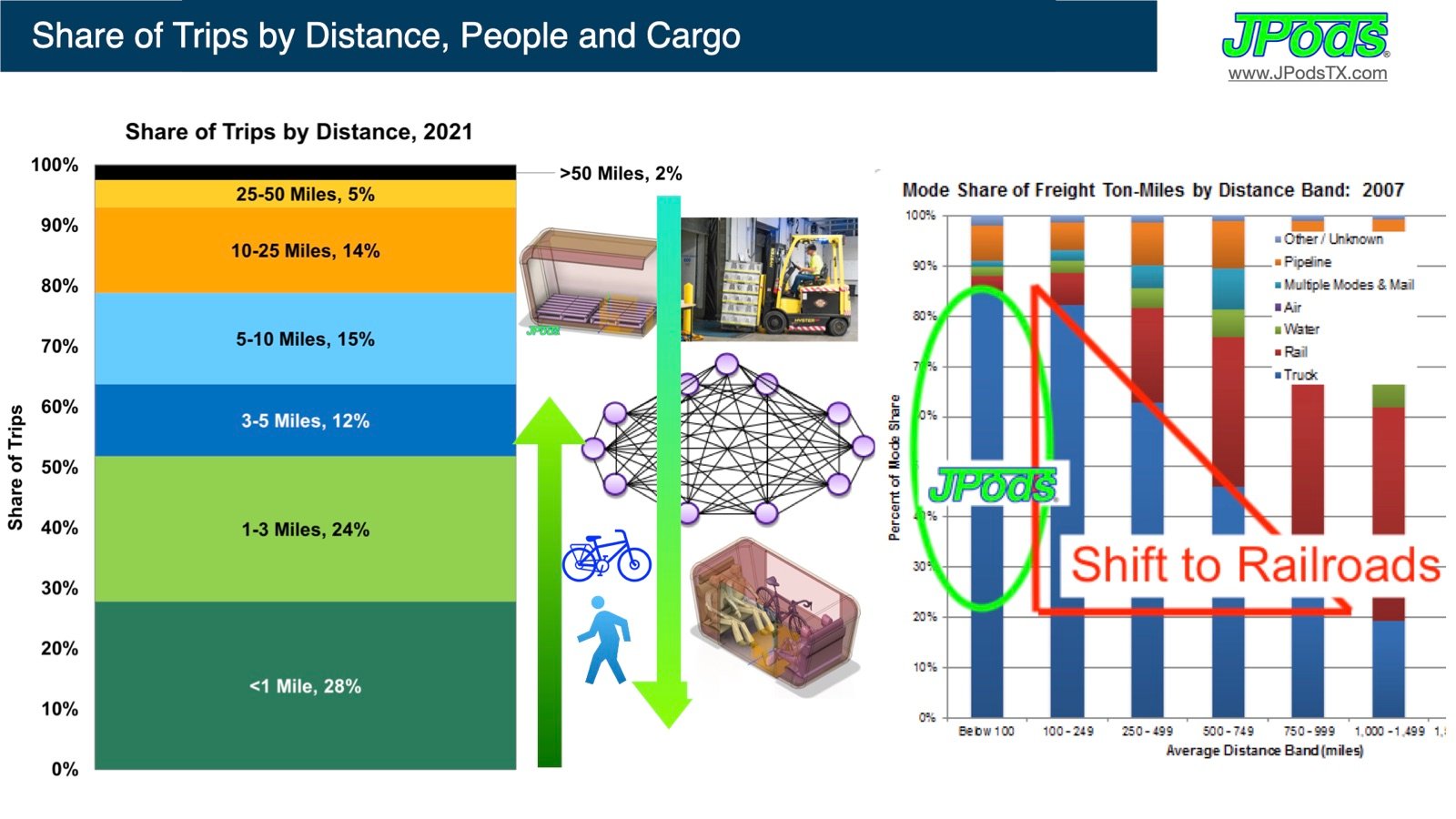
Below about 500 miles, trucks carry most of the ton-miles. Past that distance, freight shifts to rail.
FHWA Freight Analysis Framework, 2007, chart below
What the mesh brings to a railroad
A steady feed of freight that already sits in standard subcontainers, aggregated onto pallets and into ISO containers at the terminal, ready for the train. Shippers too small to fill a container share one. The city leg no longer needs a truck on the highway, so the trip that used to be a truck trip end to end becomes a rail trip in the middle.
What a railroad brings to the mesh
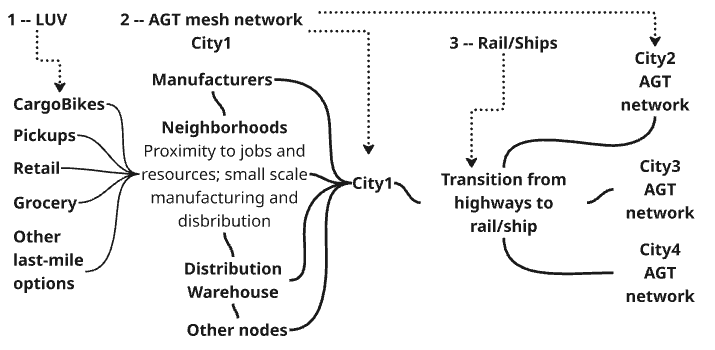
Rights of way, terminals, and the most energy-efficient long haul on land. A city guideway network without rail is a local delivery system. Connected to rail, every city network becomes a node in a national freight web, the way the application's FIG. 1 links City1 to City2, City3 and City4.
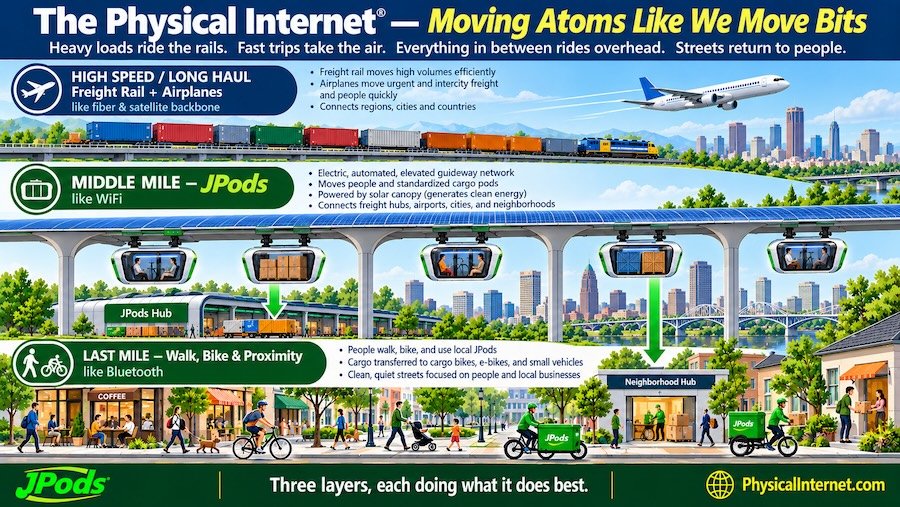
The three tiers
One subcontainer, three handoffs.
Rail between cities
Trains, aircraft or tubes move standardized subcontainers between cities, aggregated into standard railroad, aircraft and tube-network containers.
The AGT mesh inside the city
Grade-separated guideways and autonomous vehicles link rail terminals to neighborhoods, manufacturers and distribution warehouses, streaming subcontainers on schedule.
Local-use vehicles
Cargo bikes, pickups, vans, retail and grocery deliver within the neighborhood. Racking and material handling load subcontainers into them. Meet the makers.
From the application
The system forms a physical and digital logistics web across three tiers. The long-haul tier includes trains, aircraft, or tubes that move standardized subcontainers between cities. The middle-mile tier comprises AGT networks linking rail terminals to neighborhoods through grade-separated guideways and autonomous vehicles. The last-mile tier uses LUVs for delivery within neighborhoods.Detailed description, U.S. 19/356,062 as filed
The subcontainer
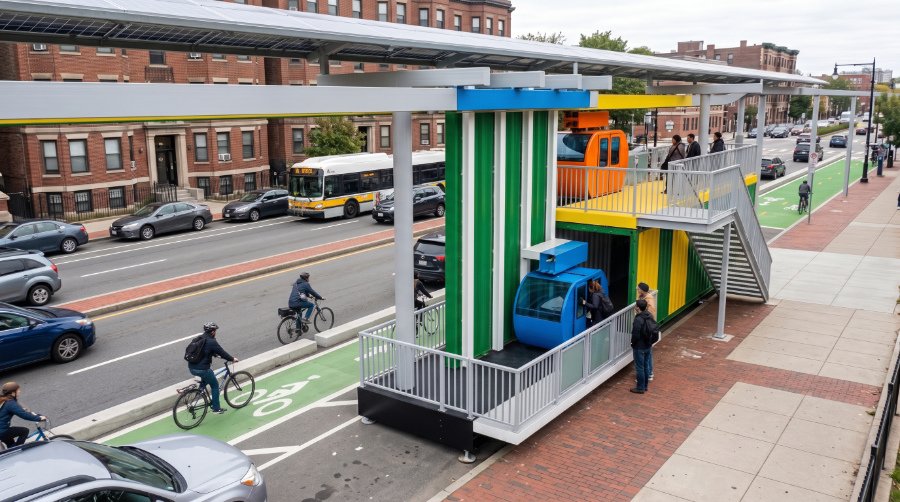
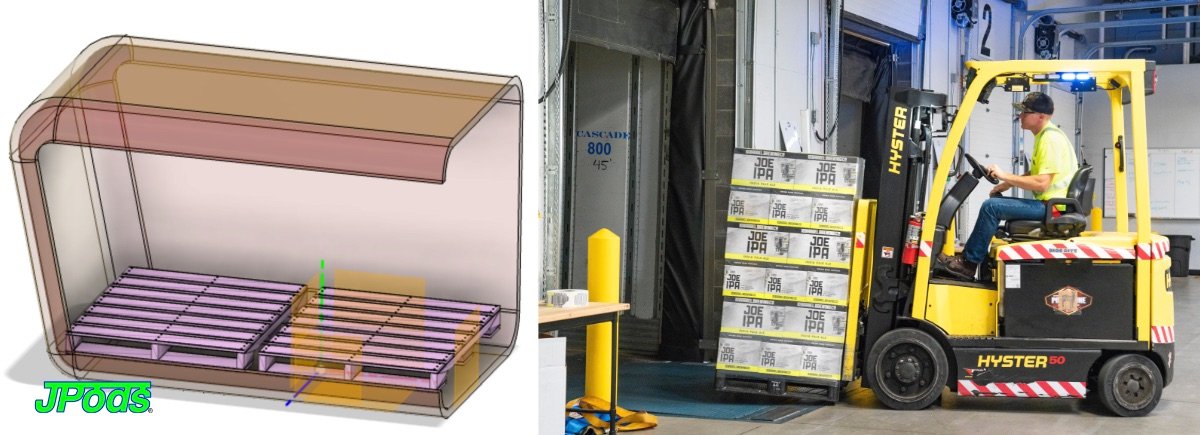
Small enough for a cargo bike. Built to stack into a railcar.
The standard subcontainer is the packet of this network. The application describes it as compatible across every mode, with:
- dimensions and payload sized for the guideway and for local vehicles;
- features that let it aggregate onto pallets and into standard railroad, aircraft and tube-network containers;
- a modular design for variable shapes and capacities;
- at least one inflatable air bladder that steadies the contents in transit and detects an unauthorized opening;
- a sensor suite: accelerometer, temperature, geolocation and tamper detection;
- smart-tracking and smart-locking components that record location, environment and custody.
Claim 18, as filed on October 10, 2026, covers the subcontainer itself.
Chain of custody
Every handoff is a record.
Three tiers mean at least two handoffs, and handoffs are where freight is damaged, delayed or lost. The application ties the subcontainer's sensors to a blockchain-based ledger. It logs impacts, temperature excursions, location changes and tamper attempts as an immutable record, with image or sensor logs of the cargo's condition at each custody transfer.
Access to shipping information is permissioned. Private data is encrypted so only authorized key holders can read it. Smart-contract modules can automate the shipping agreement between the carriers of each tier.
Claims 15, 19 and 20 as filed.
- ImpactThe accelerometer records a drop or a hard coupling, and which tier held the subcontainer when it happened.
- TemperatureAn excursion outside the shipment's limits is logged with the time and place.
- LocationGeolocation marks each move: railcar, terminal, guideway, hub, bike.
- TamperThe air bladder and the tamper sensor detect an unauthorized opening.
- TransferAn image or sensor log documents the cargo's condition as custody passes to the next carrier.
Load and unload windows
Rail capacity anyone can book.
A train runs on a schedule; a city runs on demand. The application closes that gap with large language models. They define load and unload windows for long-haul container movements, and describe each window in plain language so that a shop owner, not just a logistics professional, can find and use it.
Each window specifies at least the load and unload times, cargo classifications, hazard requirements, volume (cube) limits and gross-weight limits. Routing-control modules then schedule the guideway network to stream subcontainers to the terminal just in time for the window. The models can also combine a customer's private data with system-wide data to forecast shipments for customers and carriers, with the private data encrypted.
Claims 21 to 23 as filed. The example at right is an illustration, not a format from the application.
“There's room on Tuesday's train to Kansas City for about forty subcontainers of ordinary goods. Have them at your hub by 1 pm and they'll be there Wednesday morning.”
The transactions
Free, open-source software for every handoff.
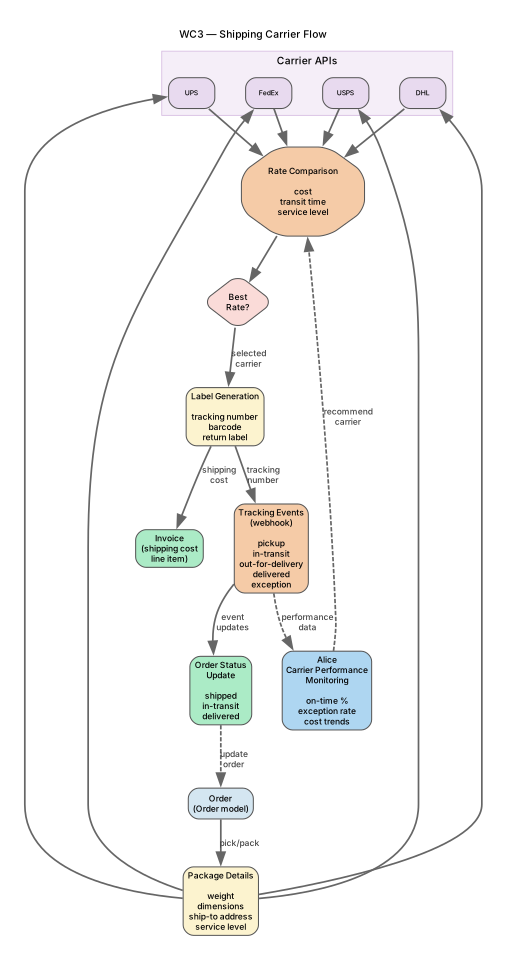
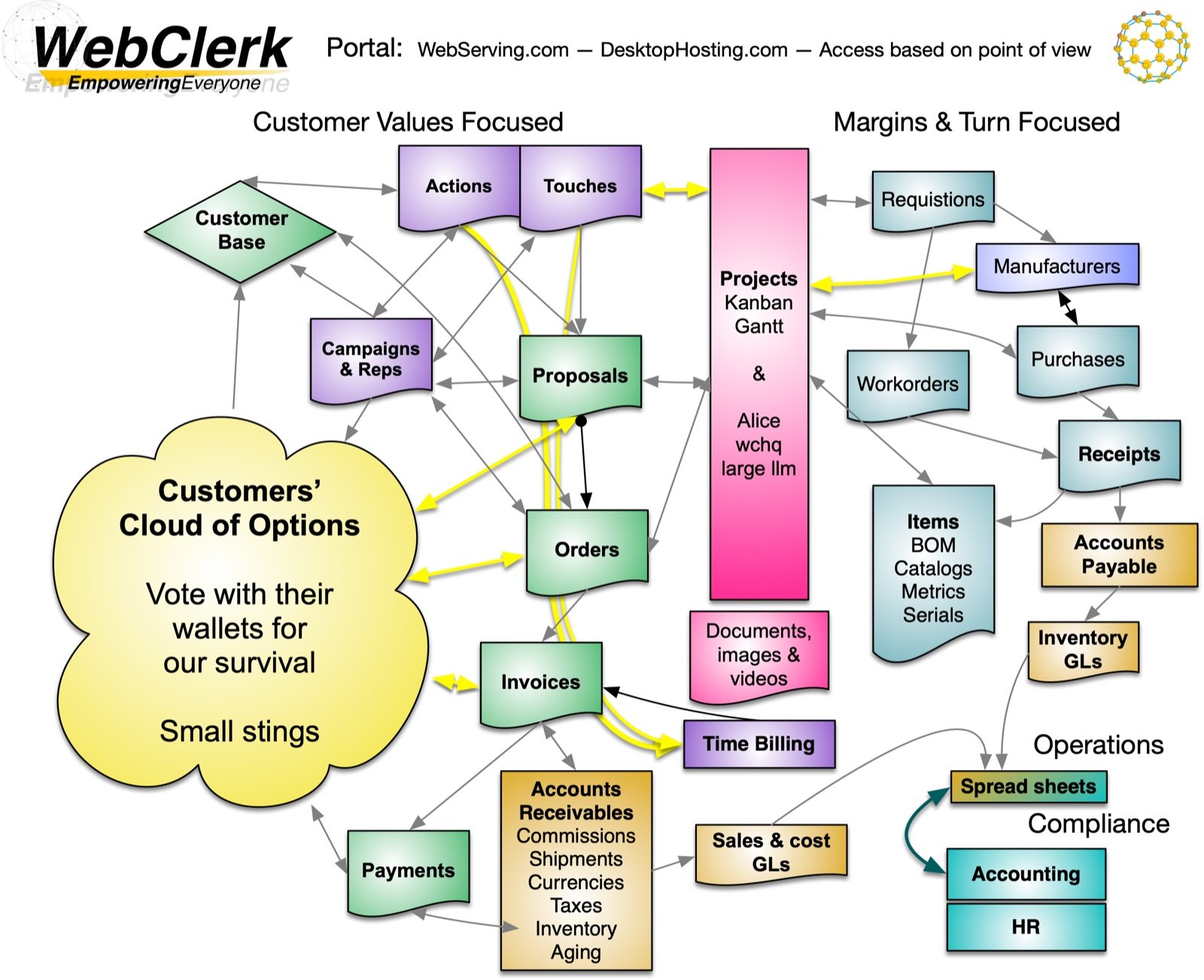
Every handoff between tiers is also a business transaction: a booking, a purchase order, a receipt, an invoice, a payment. Three tiers and many small carriers will not share one company's system, and they should not have to. WebClerk is the JPods answer: enterprise commerce software that is free and open source under the Apache 2.0 license.
- Standalone. A short line, a terminal operator or a cargo-bike company can run WebClerk on its own computer to handle contacts, proposals, orders, purchases, receipts, invoices, payments and inventory.
- Connected by API. A railroad that already has its own systems keeps them. WebClerk's API uses one pattern for every record, so a railroad's systems can exchange bookings, custody events and invoices with the guideway network and the last-mile carriers without replacing anything.
- Each party keeps its own data. Customers, prices and relationships stay with the business that owns them, and the owner decides who sees what.
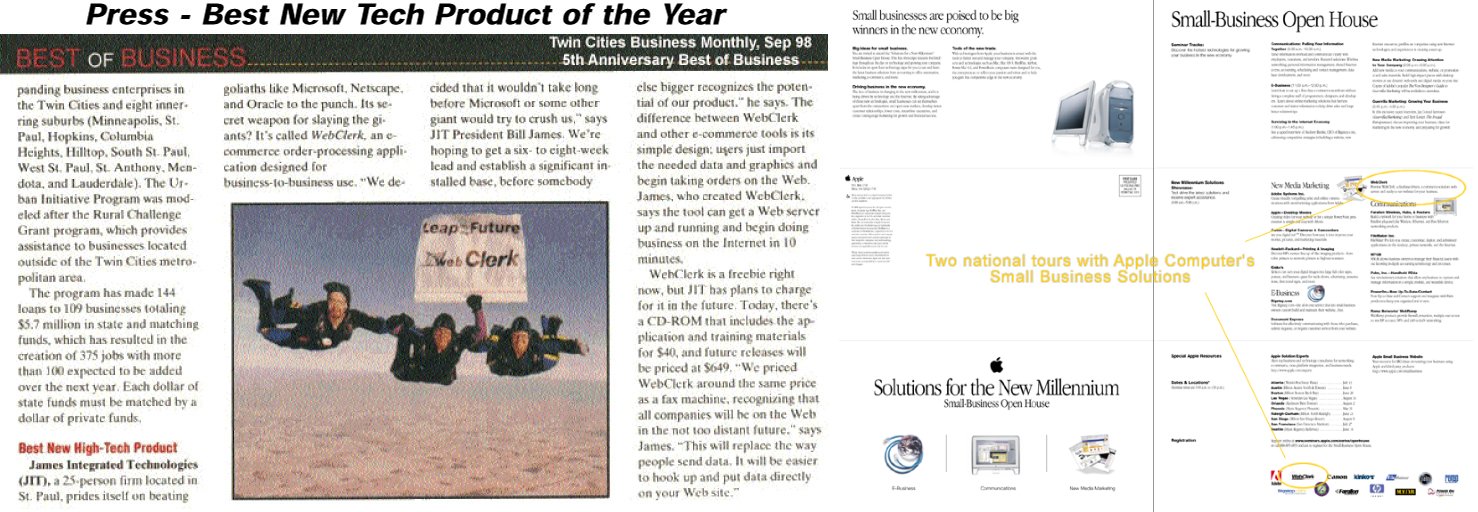
Proven early. Twin Cities Business Monthly named WebClerk the Best New High-Tech Product of 1998. Apple Computer then invited it on two national tours, the Solutions for the New Millennium small-business open houses.
The source is public at github.com/JPods/WebClerk.
Energy and pavement
Fewer truck miles, less fuel, longer-lasting roads.
The application states that the three-tier system reduces energy use to below 45 percent of highway trucking, decreases pavement damage and increases logistics resilience. Its reporting modules turn measured shipment energy use into environmental-benefit and carbon-credit reports (claim 17), so the savings can be documented shipment by shipment.
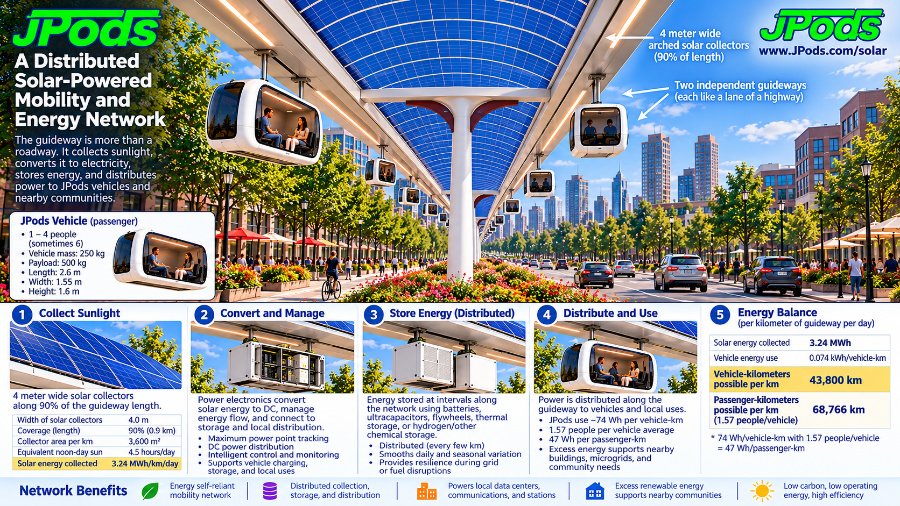
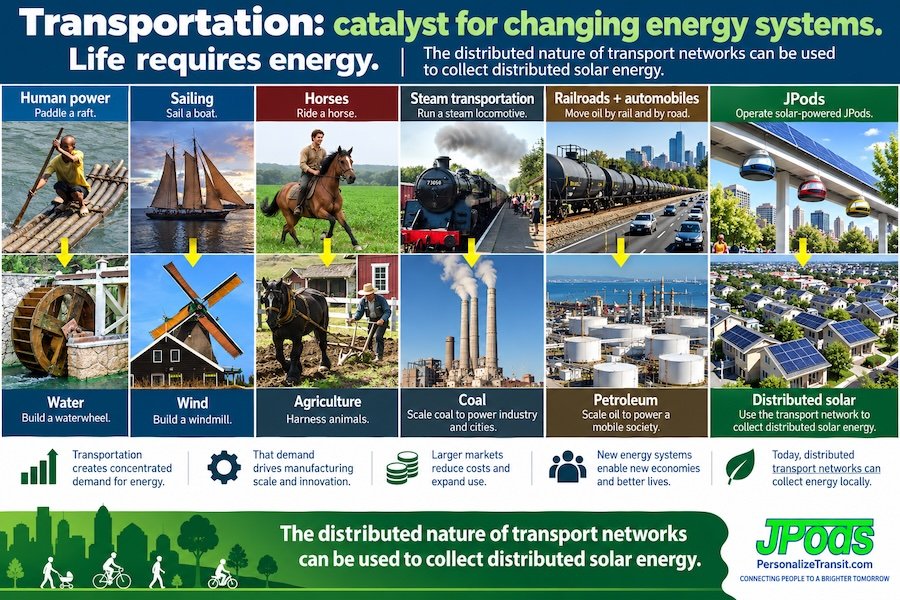
The middle tier can generate its own power. A JPods guideway carries solar collectors along its length, so the city leg runs on sunlight collected over the route it travels. The energy-self-reliant guideway is the subject of a related JPods application.
Resilience
When roads fail, freight still moves.
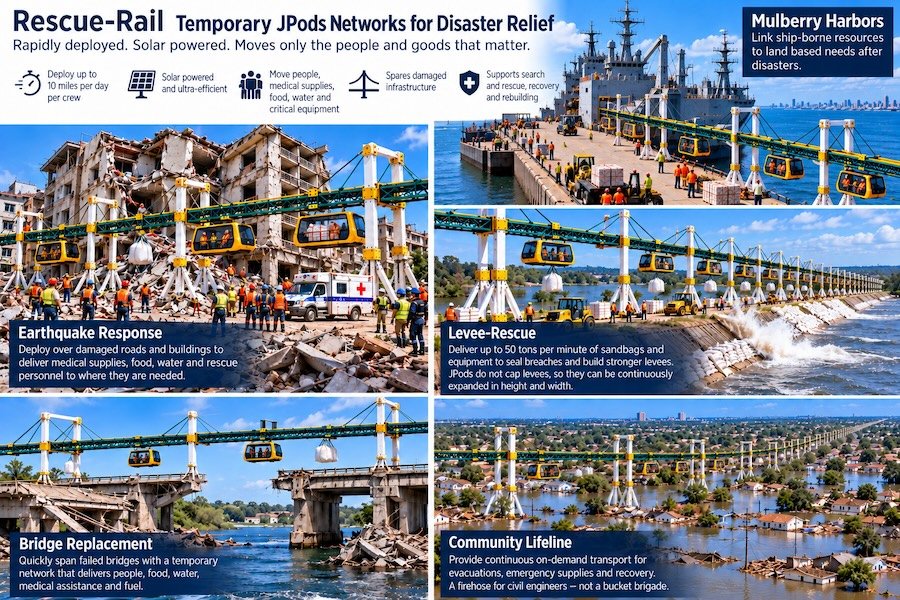
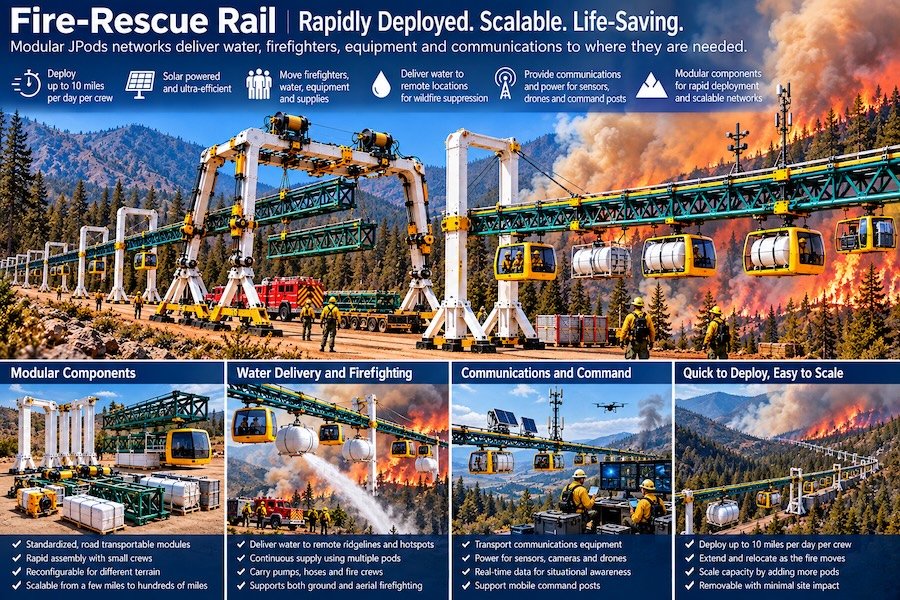
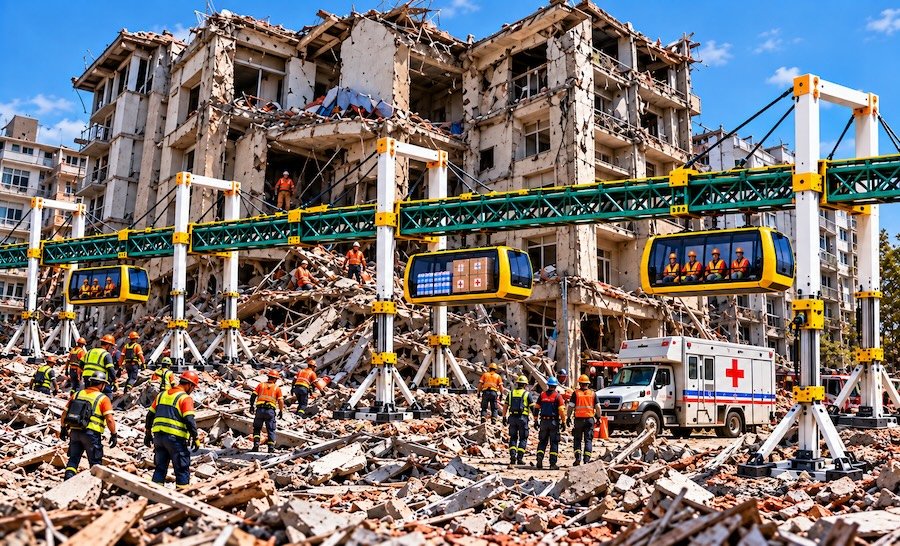
A truck-dependent city stops when its roads are blocked by flood, fire, earthquake or a bridge out. A network of many small pods on many routes routes around the damage. The same lightweight guideway can be put up temporarily to reach a disaster zone and carry relief from the railhead or the port. That temporary deployment is Rescue Rail, the subject of a related JPods application.
1864
Rights of way and capital built the rail network once.
The Pacific Railroad Act of 1862 granted the right of way; the 1864 amendments got the balance of right of way and capital right. Capital followed, and the United States built a rail network of more than 250,000 miles by the 1910s. About 140,000 miles remain, and much of the freight they lost went to highways.
The rail network still holds what a city freight mesh needs most: rights of way, terminals, and the long haul. CargoMesh is a way to bring the short miles back to the rails.
What prudent merchant will hazard his fortunes in any new branch of commerce when he knows not but that his plans may be rendered unlawful before they can be executed?James Madison, Federalist No. 62
Railroad allies
We are looking for railroads to build this with.
CargoMesh needs partners who own the long haul and the terminals. Useful starting points:
- A terminal for a pilot. One intermodal or transload yard where a guideway network can meet the rails and exchange subcontainers.
- The interchange. How subcontainers aggregate onto pallets and into your containers, and how they come back out at the other end.
- Booking windows. Which train capacity could be offered as plain-language windows to shippers who never book rail today.
- A city pair. Two cities on your network where a mesh at each end would turn short-haul truck freight into rail freight.
- Short lines and regionals. Smaller railroads close to cities may be the first and best fit.
The patent application
Automated Guideways Facilitating 3-Tiered Cargo Shipments
Abstract, as filed
A system and method integrate railroads, automated guideway transit (AGT) networks, and local-use vehicles (LUVs) into a three-tier logistics chain. Standardized subcontainers, compatible across all tiers, may include adaptive air bladders and sensor suites (accelerometer, temperature, geolocation, tamper detection) for cargo stabilization and monitoring. A blockchain ledger records sensor data for verifiable chain of custody, while machine learning optimizes routing and aggregation. Large language models (LLMs) define load and unload windows for inter-city containers, enabling AGT networks to stream subcontainers for just-in-time compliance. The system reduces energy use to below 45 percent of highway trucking, decreases pavement damage, and increases logistics resilience. Unlike prior systems, the invention unites grade-separated AGT middle-mile transport with secure, sensor-monitored subcontainers and LLM-scheduled operations.
Independent claims, as filed October 10, 2026
- Claim 13 · the system. A transport system of three tiers: a long-haul tier moving standardized subcontainers between cities by rail, aircraft or tube; a middle-mile tier of grade-separated AGT guideways and autonomous vehicles within cities; and a last-mile tier of local-use vehicles, coordinating transfers of the subcontainers across the tiers.
- Claim 18 · the subcontainer. A body sized for AGT and local-use vehicles that aggregates into pallets and standard containers, with at least one inflatable air bladder that stabilizes the contents and detects unauthorized openings, and a sensor suite of accelerometer, temperature, geolocation or tamper-detection sensors.
- Claim 21 · the scheduling system. Large language models that define load and unload windows for long-haul container movements, describe them in natural language for non-expert users, and drive routing control that schedules the AGT network to the windows.
Summaries of the claims. The claims as examined by the USPTO define what the application covers.
- Application
- U.S. 19/356,062, nonprovisional
- Filed
- October 11, 2025
- Inventor
- William Dean James, Tulsa, Oklahoma
- Status
- Patent pending; petition to revive filed October 10, 2026
- Related
- U.S. Patent 6,810,817; JPods applications on energy self-reliant, temporary and border-security guideway networks. See all JPods patents.